Anthropic absorbs Stainless, jury clears OpenAI, Willison times the agent leap
Anthropic locks up the SDK pipeline rivals depend on, an advisory jury clears OpenAI on timing, and Willison dates the agent breakthrough.
Anthropic absorbs Stainless, jury clears OpenAI, Willison times the agent leap
TL;DR
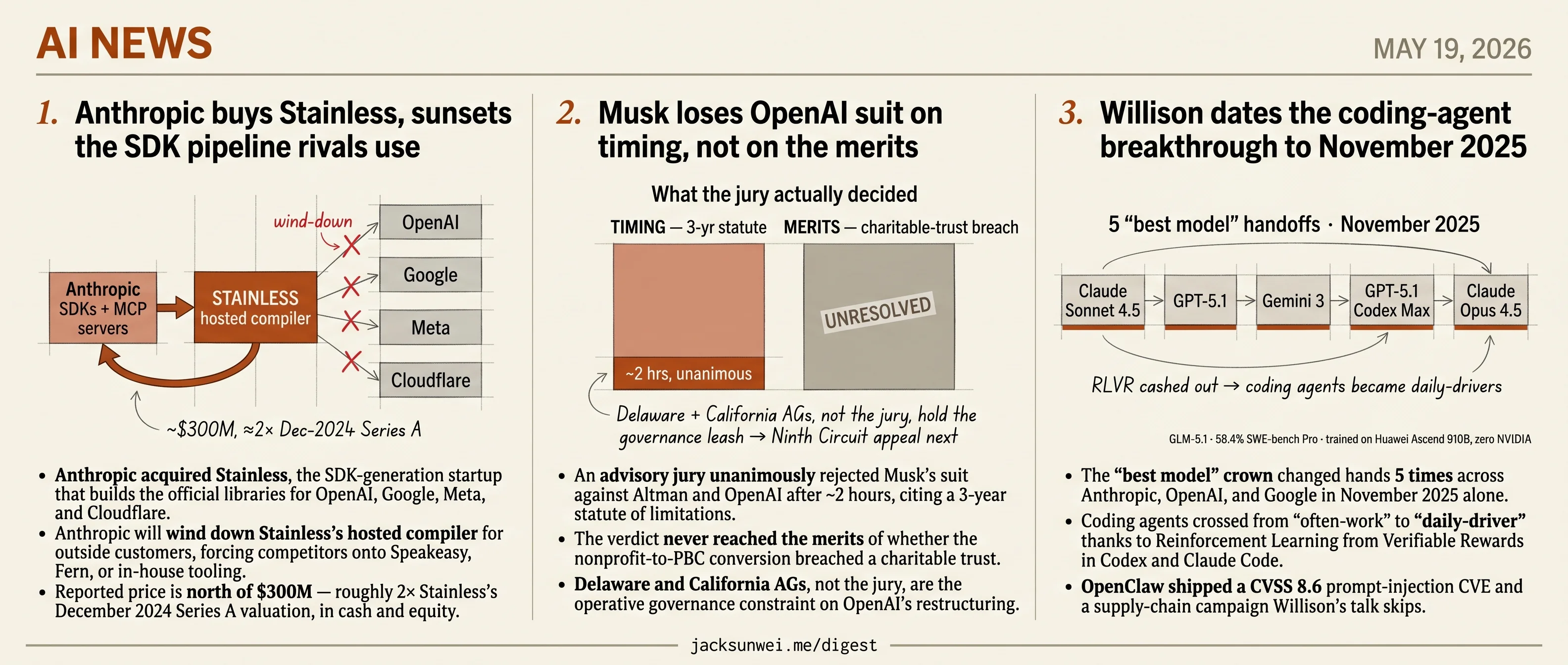
- Anthropic buys SDK shop Stainless for $300M+, winding down the compiler OpenAI, Google, and Meta use.
- Advisory jury rejects Musk’s OpenAI suit in 2 hours, citing a 3-year statute of limitations.
- Willison dates the coding-agent breakthrough to November 2025, when the best-model crown changed hands 5 times.
- OpenAI and Dell bring Codex to on-prem deployments for regulated industries blocked from cloud-only AI.
- Google enters I/O as a distant third in frontier models, per MIT Tech Review.
Today’s three features each touch a different axis of the frontier-lab story. Anthropic spends north of $300M to buy Stainless, the SDK-generation shop that ships the official client libraries for OpenAI, Google, Meta, and Cloudflare — and plans to wind down the hosted compiler rivals depend on. A San Francisco advisory jury rejects Musk’s suit against Altman and OpenAI in roughly two hours, but on a statute-of-limitations technicality that never reaches the nonprofit-to-PBC merits. And Simon Willison, in a conference retrospective, dates the moment coding agents became daily-drivers to November 2025 — a month when the best-model crown traded hands five times.
The briefs widen the lens to deployment: OpenAI and Dell push Codex on-prem for regulated buyers, SandboxAQ wraps drug-discovery models in Claude for non-coders, and Anduril and Meta prototype an AR headset that calls drone strikes by eye. Google heads into I/O this week with ground to make up.
Anthropic buys Stainless, sunsets the SDK pipeline rivals use
Source: anthropic-news · published 2026-05-18
TL;DR
- Anthropic acquired Stainless, the SDK-generation startup that builds the official libraries for OpenAI, Google, Meta, and Cloudflare.
- Anthropic will wind down Stainless’s hosted compiler for outside customers, forcing competitors onto Speakeasy, Fern, or in-house tooling.
- Reported price is north of $300M — roughly 2× Stainless’s December 2024 Series A valuation, in cash and equity.
- The deal doubles as an MCP-server factory play, concentrating connector generation despite unresolved privilege-escalation and tool-poisoning risks.
The acquisition is an infrastructure-denial play
Anthropic’s own announcement frames the Stainless deal as a way to “strengthen agent connectivity” and accelerate Model Context Protocol tooling. That’s the polite version. The lede everywhere else is that Stainless generates the official SDKs for OpenAI, Google, and Meta — and Anthropic is winding down the hosted compiler those competitors depend on 12. Existing generated libraries keep working; the automated update pipeline does not. Rivals now have to migrate to Speakeasy, Fern, or LibLab, or stand up their own generator.
Forbes called it “a calculated, high-stakes grab for the plumbing of an entire industry” 1. That reading is hard to argue with. Stainless has built every official Anthropic SDK since the Claude API launched, and it ships idiomatic libraries in TypeScript, Python, Go, Java, and Kotlin — the surface area developers actually touch. Owning that surface area for yourself while pulling it out from under your three biggest model rivals is a different kind of acquisition than the announcement copy suggests.
The MCP angle is the under-discussed half
The agent-connectivity pitch isn’t just spin. Stainless’s roadmap at Anthropic, per founder Alex Rattray on HN, is “the incredibly ‘boring’ infrastructural work of making ‘boring’ APIs like HubSpot’s more usefully accessible” 3 — i.e., turning the long tail of SaaS APIs into MCP servers Claude can drive. If MCP becomes the universal connector standard Anthropic wants, owning the dominant code-generation factory for MCP servers is leverage that compounds.
The catch is that MCP’s security model is not in great shape. CyCognito’s protocol analysis flags that MCP servers routinely execute with their own elevated privileges rather than the calling user’s, creating a confused-deputy path to unauthorized resources 4. Tool-name collisions enable “tool poisoning,” and audit/encryption guarantees lag what regulated sectors expect. Concentrating MCP-server generation under one vendor doesn’t fix those issues; it scales them.
The technical caveats and the dissent
Independent SDK-generator comparisons add nuance the press release omits. Speakeasy’s writeup notes Stainless is REST-only — no gRPC, no WebSockets, no Server-Sent Events 5. That matters because agentic workloads increasingly stream, and the labs Anthropic just cut off have the budget to fund alternatives that don’t have those gaps.
Developer reaction on HN split predictably. Rattray’s “boring infrastructure” framing landed with some 3; others were less charitable:
What’s WILD is people ending up relying on these essentially startup-slops that just serves to give you future technical debt 6
The skeptics’ point is that the moat may be months, not years. OpenAI and Google can rebuild a compiler; the harder question is whether any of them want to depend on a shared dev-tools vendor again after watching this one get acquired and partially sunset.
What’s actually at stake
Two things. First, whether vertical integration of developer tooling becomes the new normal — Anthropic has now done with Stainless what it did with Bun and Vercept, and the pattern suggests a thesis that the “factory” matters more than the model. Second, whether MCP’s security debt gets paid down before the connector ecosystem gets too big to refactor. The acquisition headline got more scrutiny than either question deserves on its own.
Further reading
Musk loses OpenAI suit on timing, not on the merits
Source: the-verge-ai · published 2026-05-18
TL;DR
- An advisory jury unanimously rejected Musk’s suit against Altman and OpenAI after ~2 hours, citing a 3-year statute of limitations.
- The verdict never reached the merits of whether the nonprofit-to-PBC conversion breached a charitable trust.
- Delaware and California AGs, not the jury, are the operative governance constraint on OpenAI’s restructuring.
- Musk is appealing to the Ninth Circuit, calling the ruling a “free license to loot charities.”
A timing ruling dressed up as vindication
Every major outlet converged on the same caveat the OpenAI press release will not: the unanimous verdict turned on the discovery rule, not on whether Sam Altman and Greg Brockman actually breached a charitable trust when they steered OpenAI’s nonprofit into a capped-profit and then a public-benefit corporation. The advisory jury found two of Musk’s claims time-barred and a third dependent on a dismissed count. As Local News Matters put it, the “blockbuster AI trial ends without answering its biggest questions” 7.
That gap is the whole story. A GeekWire opinion piece warned readers not to “let the OpenAI soap opera hide the precedent” being quietly set for future nonprofit conversions 8. Musk took the same opening from the other side, branding Judge Yvonne Gonzalez Rogers an “activist” on X and vowing an appeal centered on when he could reasonably have discovered the alleged breach 9.
The testimony the verdict buried
Because the case died on timing, the trial’s most damaging disclosures got no judicial resolution — they just sit there, on the record, unadjudicated.
Altman testified that in 2017 Musk demanded a 90% equity stake and total control of OpenAI, floating a merger with Tesla and eventual succession to his children — an account Altman called “hair-raising” 10. The defense used it to recast Musk as a thwarted would-be owner, not a betrayed donor.
Cutting the other way, former CTO Mira Murati testified that Altman exhibited a “consistent pattern of lying” and routinely undermined his own leadership team 11:
“consistent pattern of lying”
Neither narrative was tested by a verdict. Both will outlive it.
The regulatory backstop the coverage under-reports
Most write-ups barely mention that the operative constraints on OpenAI’s structure were imposed months ago by state attorneys general, not this jury. Delaware AG Kathy Jennings’s October 2025 review required the nonprofit parent to retain control of the PBC, hold a roughly $130B equity stake, seat independent members on the safety committee, and submit to quarterly monitoring 12. California’s parallel review reached compatible terms.
Reading the verdict as a clean win overstates how much the jury settled. The PBC conversion is governed by those AG agreements — which Public Citizen and a 50+ organization coalition argue leave the nonprofit’s control “illusory” — not by anything that happened in Oakland this week.
What’s actually resolved
Three things, no more:
- OpenAI clears an existential litigation overhang ahead of a reported ~$1T IPO path.
- Musk’s standing as a self-styled mission guardian takes a public hit; Altman’s as a steward takes a quieter one.
- The discovery-rule question — when Musk knew enough to sue — moves to the Ninth Circuit.
What’s not resolved: whether converting a charity chartered for “the benefit of humanity” into a capital-raising PBC is lawful when the charity’s original donors object. That precedent is still up for grabs, and the next venue will be either Musk’s appeal or the next AG to look hard at a nonprofit-to-for-profit AI lab. The jury punted; the governance fight has not.
Further reading
- Elon Musk has lost his lawsuit against Sam Altman and OpenAI — techcrunch-ai
- Musk v. Altman proved that AI is led by the wrong people — the-verge-ai
- Elon Musk took too long to sue OpenAI, jury unanimously agrees — ars-technica-ai
- Here’s why Elon Musk lost his suit against OpenAI — mit-tech-review-ai
Willison dates the coding-agent breakthrough to November 2025
Source: simon-willison · published 2026-05-19
TL;DR
- The “best model” crown changed hands 5 times across Anthropic, OpenAI, and Google in November 2025 alone.
- Coding agents crossed from “often-work” to “daily-driver” thanks to Reinforcement Learning from Verifiable Rewards in Codex and Claude Code.
- OpenClaw shipped a CVSS 8.6 prompt-injection CVE and a supply-chain campaign Willison’s talk skips.
- GLM-5.1 hit 58.4% on SWE-bench Pro trained entirely on Huawei Ascend 910B chips — frontier performance with zero NVIDIA silicon.
The November inflection, in one slide
Simon Willison’s PyCon US 2026 lightning talk compresses six months of LLM history into one claim: November 2025 was when it all snapped into place. Five “best model” handoffs in a single month — Claude Sonnet 4.5 → GPT-5.1 → Gemini 3 → GPT-5.1 Codex Max → Claude Opus 4.5 — but the bigger story was underneath the leaderboard. OpenAI and Anthropic’s year-long bet on Reinforcement Learning from Verifiable Rewards finally cashed out: coding agents in Codex and Claude Code stopped requiring babysitting on routine tasks.
Independent benchmarks back this up. GLM-5.1 scored 58.4% on SWE-bench Pro, surpassing GPT-5.4 and Claude Opus 4.6 13. The capability shift is real.
The OpenClaw asterisk
Willison frames “Claws” — the new generic for local personal assistants spawned by the Warelay → CLAWDIS → OpenClaw lineage — as a charming pet phenomenon, complete with Drew Breunig’s quip that a Mac Mini is “the perfect aquarium for your Claw.” The Mac Mini run on Silicon Valley is documented; some developers are racking up to 12 units to run specialized agents in parallel 14. He even reaches for Doc Ock’s inhibitor chip as a safety metaphor, played for laughs.
The joke landed harder than intended. CVE-2026-27001 is a CVSS 8.6 prompt-injection flaw in OpenClaw where the framework embeds an unsanitized working-directory path into the system prompt, letting attackers “speak as the system.” It shipped alongside the ClawHavoc supply-chain campaign that planted 800+ malicious skills in ClawHub, harvesting AMOS infostealers and wallet keys 15. The inhibitor chip failed in February.
The vibe-coded sprawl Willison self-deprecates about — his retired holiday projects, the “LLM psychosis” — also has an ugly external face. Docker’s security team measured AI-assisted commits leaking secrets at 3.2% vs. 1.5% for human-only baselines, and OWASP made prompt injection the #1 threat of 2025 16. Elektor is calling for a “Challenger disaster” reckoning as thousands of ownerless February-mania apps start failing in production 17.
Open weights without NVIDIA
Willison flags GLM-5.1 as a 1.5TB “monster” but undersells the geopolitics. The model was trained entirely on Huawei Ascend 910B chips — a frontier-tier result with no NVIDIA in the loop 13. That’s the headline buried in the parameter count. Qwen3.6-35B-A3B beating Claude Opus 4.7 on a laptop is the consumer-facing story; GLM-5.1 on Ascend is the export-control one.
The pelican has been Goodharted
Willison himself concedes the pelican-on-a-bicycle test has saturated. Critics go further: Grokipedia logs accusations of training-set contamination, no control group, and models “helpfully over-engineering” outputs with unrequested suns and hats 18. Jeff Dean’s animated menagerie — frogs on penny-farthings, turtles kickflipping — reads to Willison as labs paying attention. To skeptics, it reads as labs optimizing to a meme.
The two themes hold: agents got good, local models surprised. The risk register Willison skipped is the rest of the talk someone needs to give.
Round-ups
Google enters I/O as a distant third in foundation models
Source: mit-tech-review-ai
Ahead of this week’s developer conference, MIT Tech Review’s Algorithm newsletter sizes up Google’s position one year after Gemini’s debut: clearly behind OpenAI and Anthropic in the frontier-model race, with pressure mounting to show breakthroughs across Gemini, Search, and Android.
OpenAI and Dell bring Codex to on-prem enterprise deployments
Source: openai-blog
The partnership lets enterprises run OpenAI’s Codex coding agent in hybrid and on-premise environments alongside Dell infrastructure. The pitch targets customers blocked from cloud-only AI by data-residency and security rules, giving regulated industries a path to agentic coding inside their own data centers.
SandboxAQ plugs drug-discovery models into Claude for non-coders
Source: techcrunch-ai
The Alphabet spinout is exposing its biomolecular simulation models through Anthropic’s Claude so researchers without computing PhDs can run them in natural language. The bet: while rivals like Chai Discovery and Isomorphic Labs chase model quality, accessibility is the real bottleneck in pharma AI.
Anduril and Meta prototype AR headset that calls drone strikes by eye
Source: mit-tech-review-ai
The defense-tech firm and Meta are building a military augmented-reality headset that lets soldiers order drone strikes through eye-tracking and voice commands. Anduril VP Quay Barnett, a former Army Special Operations officer, is leading the effort and shared fresh details on the prototype.
Ukrainian drone founder warns West is unprepared for AI warfare
Source: latent-space
Yaroslav Azhnyuk, who pivoted from pet cameras to AI-guided weapons through his startup The Fourth Law, joins guest host Noah Smith to argue Western militaries are asleep at the wheel as autonomous drones reshape the front lines in Ukraine.
Alexa+ generates on-demand AI podcasts on any topic
Source: the-verge-ai, techcrunch-ai
Amazon’s upgraded assistant now spins up custom podcast episodes from a user prompt, previewing what its AI hosts plan to discuss and letting listeners steer the conversation mid-stream. The feature pushes Alexa+ toward a personalized AI content platform, echoing Google’s NotebookLM audio overviews.
Import AI 457 covers AI Stuxnet, Muon optimizer quirks, positive alignment
Source: import-ai
Jack Clark’s latest issue digs into the prospect of an AI-built Stuxnet-style cyberweapon, oddities in the Muon optimizer gaining traction for LLM training, and a framing of alignment as a positive design goal rather than purely a safety constraint.
Footnotes
-
Forbes (Sandy Carter) — https://www.forbes.com/sites/sandycarter/2026/05/18/anthropic-buys-stainless-to-cut-off-openai-and-google-sdk-access/
↩ ↩2Anthropic now owns the SDK layer its fiercest competitors rely on to reach developers… a calculated, high-stakes grab for the plumbing of an entire industry.
-
TechCrunch via daily.dev recap — https://app.daily.dev/posts/anthropic-acquires-stainless-the-company-behind-its-sdks-4d5kcdxyy
↩Anthropic has confirmed it will wind down Stainless’s hosted products, effectively cutting off these competitors from the automated toolchain they currently rely on to reach developers.
-
Hacker News comment (Stainless founder Alex Rattray) — https://news.ycombinator.com/item?id=48182630
↩ ↩2the incredibly ‘boring’ infrastructural work of making ‘boring’ APIs like Hubspot’s more usefully accessible is absolutely the kind of thing I’m excited to do at Anthropic
-
CyCognito MCP security analysis — https://www.cycognito.com/learn/ai-security/mcp-security/
↩MCP servers often execute actions with their own elevated privileges rather than the end-user’s, allowing users to indirectly access unauthorized resources
-
Speakeasy SDK generator comparison — https://www.speakeasy.com/blog/comparison-sdk-generators-openapi
↩Stainless focuses heavily on high-quality REST SDKs but currently lacks support for gRPC, WebSockets, and Server-Sent Events (SSE)
-
Hacker News thread (critical commenter) — https://news.ycombinator.com/item?id=48182281
↩What’s WILD is people ending up relying on these essentially startup-slops that just serves to give you future technical debt
-
Local News Matters (trial recap, Day 13) — https://localnewsmatters.org/2026/05/18/musk-v-altman-day-13-blockbuster-ai-trial-ends-without-answering-its-biggest-questions/
↩Blockbuster AI trial ends without answering its biggest questions
-
GeekWire op-ed — https://www.geekwire.com/2026/opinion-dont-let-the-openai-soap-opera-hide-the-precedent/
↩Don’t let the OpenAI soap opera hide the precedent
-
Business Insider (Musk appeal) — https://www.businessinsider.com/elon-musk-appeal-lawsuit-openai-verdict-2026-5
↩Musk criticized the ruling on X… calling Judge Gonzalez Rogers an ‘activist’ and alleging the verdict provides a ‘free license to loot charities’
-
Mashable (Altman testimony coverage) — https://mashable.com/article/altman-openai-musk-trial-stand
↩Altman described as ‘hair-raising’ a 2017 proposal in which Musk allegedly demanded a 90% equity stake and total control of OpenAI, suggesting the organization be merged with Tesla or eventually passed to Musk’s children
-
TheCreatorsAI newsletter (‘Chaos Under Oath’) — https://thecreatorsai.com/p/musk-v-openai-chaos-under-oath-anthropic
↩former CTO Mira Murati, testified that Altman exhibited a ‘consistent pattern of lying’ and a tendency to undermine his own leadership team
-
Delaware AG press release (Oct 2025) — https://news.delaware.gov/2025/10/28/ag-jennings-completes-review-of-openai-recapitalization/
↩AG Jennings completes review of OpenAI recapitalization
-
llm-stats.com — GLM-5.1 benchmarks — https://llm-stats.com/models/glm-5.1
↩ ↩2GLM-5.1 scored 58.4% on SWE-bench Pro, surpassing proprietary models like GPT-5.4 and Claude Opus 4.6… trained entirely on Huawei Ascend 910B chips, proving frontier performance is possible without NVIDIA silicon.
-
mlq.ai — Clawdbot drives Mac Mini surge — https://mlq.ai/news/viral-clawdbot-ai-agent-sparks-surge-in-mac-mini-purchases/
↩Some Silicon Valley developers reportedly deploying up to 12 units simultaneously to run specialized agents… the Mac Mini M4 has become the gold standard for OpenClaw due to its Apple Silicon unified memory architecture.
-
Skywork analysis of OpenClaw security crisis — https://skywork.ai/skypage/en/openclaw-security-vulnerability/2049132683864637440
↩CVE-2026-27001 is a high-severity prompt injection flaw (CVSS 8.6) arising from the framework’s failure to sanitize the current working directory path before embedding it into the agent’s system prompt.
-
Docker blog — AI coding agent horror stories — https://www.docker.com/blog/ai-coding-agent-horror-stories-security-risks/
↩A late 2025 study found that AI-assisted commits leak secrets at a rate of 3.2% — more than double the 1.5% baseline for human-only commits… OWASP ranked prompt injection as the #1 threat for 2025.
-
Elektor Magazine — ‘Vibe Coding Hangover’ — https://www.elektormagazine.com/articles/2026-an-ai-odyssey-vibe-coding-hangover
↩Experts warn of a ‘Challenger disaster’ for coding agent security, as thousands of ‘ownerless’ applications created during the 2025 mania begin to leak data or fail due to lack of internal auditing.
-
Grokipedia — Pelican on a bicycle benchmark — https://grokipedia.com/page/Pelican_on_a_bicycle_AI_benchmark
↩A primary criticism is the risk of ‘training on the test set,’ where AI labs might specifically optimize models to succeed on this famous prompt… developers argue the benchmark lacks scientific rigor, lacking a control group or reference standard.