Anthropic forces Claude into Slack, GPT-5 Pro echoes 2022 paper, TSMC defers EUV
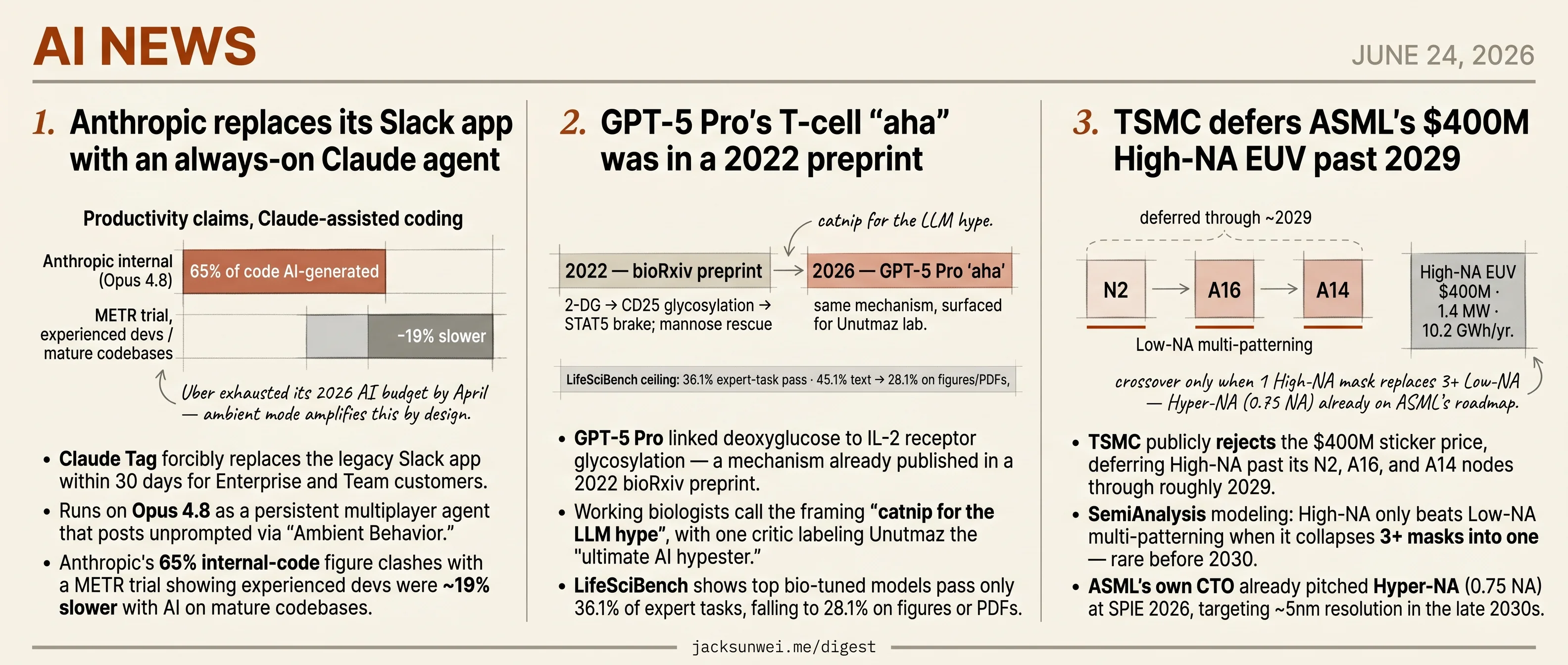
Anthropic mandates an always-on Claude agent in Slack, immunologists rebut GPT-5 Pro's T-cell discovery, and TSMC defers ASML's $400M EUV.
Anthropic forces Claude into Slack, GPT-5 Pro echoes 2022 paper, TSMC defers EUV
TL;DR
- Anthropic mandates Claude Tag’s always-on Slack agent within 30 days on Opus 4.8.
- METR trial finds experienced devs ~19% slower with AI on mature codebases.
- GPT-5 Pro’s T-cell discovery was already published in a 2022 bioRxiv preprint.
- TSMC defers ASML’s $400M High-NA EUV past its A14 node through ~2029.
- Oracle cuts 21,000 jobs to fund a debt-loaded AI data-center buildout.
Today’s three AI-news leads don’t share a thread. Anthropic forcibly replaces its legacy Slack app with Claude Tag, an always-on Opus 4.8 agent that posts unprompted via ‘Ambient Behavior’ — rolled out to Enterprise and Team customers on a 30-day timer. GPT-5 Pro is credited with a T-cell ‘aha’ that working immunologists trace to a 2022 bioRxiv preprint already in the glycobiology literature. And TSMC publicly defers ASML’s $400M High-NA EUV past its N2, A16, and A14 nodes — roughly 2029 — with SemiAnalysis modeling that the tool’s economics don’t pencil before 2030.
Beyond the leads, Oracle is funding its data-center buildout with 21,000 layoffs and rising debt, AI super PACs spent $27M trying to unseat a single New York House candidate over a model-regulation vote, and OpenAI is backing a new cross-border safety-standards foundation. A stretched-out day across product, science, fabs, and politics.
Anthropic replaces its Slack app with an always-on Claude agent
Source: anthropic-news · published 2026-06-23
TL;DR
- Claude Tag forcibly replaces the legacy Slack app within 30 days for Enterprise and Team customers.
- Runs on Opus 4.8 as a persistent multiplayer agent that posts unprompted via “Ambient Behavior.”
- Anthropic’s 65% internal-code figure clashes with a METR trial showing experienced devs were ~19% slower with AI on mature codebases.
- Uber exhausted its 2026 AI budget by April on Claude Code — a cost shape ambient mode amplifies by design.
What actually shipped
Strip the marketing and Claude Tag is a consolidation move: Anthropic is retiring the old Slack app and migrating every Enterprise and Team customer onto a single persistent-agent surface within 30 days. VentureBeat frames it bluntly — a “persistent AI teammate that learns, monitors, and works autonomously” 1. The shape is multiplayer (channel-scoped rather than 1:1), asynchronous (multi-hour and multi-day task horizons), and — the new word — ambient: the agent reads channel history continuously and can post without being @-mentioned. BNN Bloomberg reports Anthropic is already lining up wider rollouts beyond Slack, with Teams and Google Workspace the obvious next surfaces 2.
flowchart LR
    A[Slack channels<br/>tacit context] --> B{Claude Tag<br/>Opus 4.8}
    C[Codebases, CRM,<br/>scoped tools] --> B
    B -->|ambient posts| D[Channel members]
    B -.->|token burn| E[(Admin budget caps)]
    E -.reactive throttle.-> B
The scoped-identity model — separate Claude instances for Sales vs. Engineering, with per-channel token caps and full audit logs — is genuinely new and addresses real enterprise objections to shared-context agents. That part of the design is solid.
The 65% claim doesn’t travel
Anthropic’s headline proof point — 65% of its own product team’s code is now generated by the internal version of Claude Tag — is the most contested number in the launch coverage. A widely-circulated analysis juxtaposes it against METR’s randomized trial, which found experienced developers were roughly 19% slower using AI assistants on mature codebases 3. Practitioners on r/ExperiencedDevs make the sharper version of the critique: the figure plausibly counts boilerplate, scaffolding, and unused endpoints rather than load-bearing logic, and doesn’t replicate outside greenfield AI-native shops 4.
Anthropic’s number may be true. It is also almost certainly unrepresentative of what a Fortune 500 engineering org will see in month one.
Opus 4.8 is the fallback, not the frontier
The model choice is itself a story the announcement elides. Claude Tag ships on Opus 4.8 rather than the newer Fable 5 because Fable 5 was pulled globally on June 12 under a Commerce Department directive over foreign-national access concerns, leaving Opus 4.8 as the de facto production anchor for U.S. enterprise deployments 5. Enterprises evaluating multi-day autonomous workflows should price in that the substrate is the regulatory fallback, not the frontier model Anthropic would have shipped on by default.
The token-burn problem is structural
Ambient mode is, by construction, a token sink. The agent monitors continuously and posts unprompted — which is the feature, but also the bill. BuildFastWithAI’s enterprise review documents that Uber exhausted its 2026 AI budget by April after a Claude Code rollout, and Microsoft’s Experiences and Devices division canceled internal Claude Code licenses over unpredictable token costs 6. Claude Tag’s admin budget caps are real but reactive: they throttle after spend, not before. For a product whose pitch is “let it run for days without supervision,” that’s the inversion of the control surface buyers actually need.
The architectural shift is real. The economics and the productivity numbers haven’t been independently replicated, and the model underneath is there partly because the better one isn’t available.
Further reading
GPT-5 Pro’s T-cell “aha” was in a 2022 preprint
Source: openai-blog · published 2026-06-23
TL;DR
- GPT-5 Pro linked deoxyglucose to IL-2 receptor glycosylation — a mechanism already published in a 2022 bioRxiv preprint.
- Working biologists call the framing “catnip for the LLM hype”, with one critic labeling Unutmaz the “ultimate AI hypester.”
- LifeSciBench shows top bio-tuned models pass only 36.1% of expert tasks, falling to 28.1% on figures or PDFs.
- The defensible claim is workflow acceleration, not autonomous discovery — the model surfaced a glycobiology paper an immunology lab had missed.
What actually happened
Jackson Lab immunologist Derya Unutmaz had a three-year-old puzzle: T cells exposed to 2-deoxyglucose (2-DG) kept differentiating into inflammatory Th17 cells even after the drug was removed. He asked GPT-5 Pro. The model proposed that 2-DG was not starving the cells of energy but disrupting synthesis of the IL-2 signaling axis, which normally acts as a brake on Th17 commitment. OpenAI’s writeup quotes Unutmaz saying losing the tool would be “like taking both of your hands away.”
The mechanism is plausible. It is also not new.
The hypothesis was already in the literature
A 2022 bioRxiv preprint spells out the same axis in more detail: 2-DG impairs N-linked glycosylation of the IL-2 receptor subunit CD25, attenuating STAT5 signaling, with mannose — but not glucose — rescuing the phenotype 7. That is exactly the “glycosylation, not energy starvation” story GPT-5 Pro pitched, complete with the mannose-rescue experiment that Unutmaz then ran as validation. Independent analysis frames the model as a “deep connections engine” operating “within a frame built by human scientists” who curated the data and designed the confirmatory assay 8.
That reframes the news. GPT-5 Pro did not discover a mechanism; it performed fast cross-domain literature synthesis, pulling a glycobiology result into an immunology lab that had not surfaced it in three years. Useful — but a different claim than the one OpenAI is selling.
Working scientists are pushing back hard
The reception in biology Twitter has been blunt. Endpoints News quotes chemical biologist Egan Peltan calling the genre “a story in search of venture money” and Calico Labs’ Oliver Hahn dismissing it as “catnip for the LLM hype” 9.
AI Health Uncut goes harder, labeling Unutmaz the “ultimate AI hypester” and a “boy who cried rosy unicorn,” and arguing that medical progress demands rigorous evidence rather than “dopamine hits from tweets.” The same post flags a separate ME/CFS metabolic dataset where the model reportedly suggested lipid directions opposite to peer-reviewed findings 10. Nobody disputes that the IL-2/Th17 hypothesis panned out in Unutmaz’s hands. They dispute the autonomy-and-novelty narrative being built on top of it.
Access asymmetry matters
Unutmaz is a recipient of OpenAI’s “Pro AI Award” with privileged early access to GPT-5 Pro. Critics label the program “grantwashing” — award sizes ($5K–$100K) are negligible next to NIH R01s (often >$600K), and over 100 AI researchers have signed an open letter demanding legal and technical safe harbors so independent auditors can probe the same models that hand-picked award recipients showcase 11. The most public success stories come from a small, vendor-selected pool.
The ceiling outside the anecdote
The MIT Media Lab’s LifeSciBench — 750 tasks scored by 173 PhD evaluators — finds even the specialized GPT-Rosalind variant passes just 36.1% of expert-level tasks. Performance drops from 45.1% on plain text to 28.1% once the model has to interpret sequences, figures, tables or PDFs, and “design and optimization” workflows are the weakest category 12. The Unutmaz case is a text-mediated hypothesis prompt — precisely the regime where these models are strongest.
The honest version of this story is that GPT-5 Pro is now a credible literature-synthesis collaborator for wet-lab PIs. That is genuinely useful. It is not the same as a model solving a three-year mystery.
TSMC defers ASML’s $400M High-NA EUV past 2029
Source: mit-tech-review-ai · published 2026-06-23
TL;DR
- TSMC publicly rejects the $400M sticker price, deferring High-NA past its N2, A16, and A14 nodes through roughly 2029.
- SemiAnalysis modeling: High-NA only beats Low-NA multi-patterning when it collapses 3+ masks into one — rare before 2030.
- ASML’s own CTO already pitched Hyper-NA (0.75 NA) at SPIE 2026, targeting ~5nm resolution in the late 2030s.
- Each High-NA tool draws ~1.4 MW at 0.02% wall-plug efficiency, up to 10.2 GWh/year per machine.
The sticker shock the profile glosses over
MIT Technology Review’s tour of ASML’s High-NA EUV scanner reads like an inevitability piece: 150 tons of precision aluminum, $400 million per unit, the future of chipmaking. The customers tell a different story. TSMC SVP Kevin Zhang said the technology’s capabilities are impressive but the “sticker price” is not, and the foundry has skipped High-NA for its N2, A16, and A14 nodes — planning to ride Low-NA multi-patterning through roughly 2029 13. Intel, which absorbed the early EXE:5000/5200 run for 14A, is essentially alone in the aggressive-adopter camp.
“The capabilities are impressive. The sticker price is not.” — TSMC SVP Kevin Zhang 13
The economics back the skepticism. SemiAnalysis pegs a High-NA exposure at about 2.5× the cost of a Low-NA one, and the tool only wins on a per-wafer basis when it collapses three or more masks into a single exposure 14. For the double-patterning layers that dominate near-term advanced nodes, the legacy flow stays cheaper — and the crossover doesn’t arrive until roughly the end of the decade.
A roadmap already drifting past High-NA
While MIT TR treats High-NA as the destination, ASML’s own technology chief is publicly mapping the next jump. At SPIE Advanced Lithography 2026, Jos Benschop laid out Hyper-NA at 0.75 NA as the “natural next step,” targeting a 36% feature-size reduction to roughly 5 nm with high-volume manufacturing in the second half of the 2030s 15. He also flagged stochastic defects — photon shot-noise that no amount of optical engineering fully solves — as the persistent “elephant in the room.” Resolution gains keep colliding with physics that lenses can’t fix.
That’s the awkward subtext for any customer weighing a High-NA purchase order in 2026: the vendor is already telling conferences about the generation after the one you’re being asked to bet on.
The bills the glossy version skips
Two contexts the profile underweights: export controls and electricity. In mid-2026, U.S. Commerce Secretary Howard Lutnick alleged that a restricted EUV tool may have reached China. ASML rejected the claim, arguing its 180-ton machines are impossible to transport or operate without ASML service engineers and the system’s “phone home” telemetry 16. That defense is also a tacit admission of how tightly the install base is policed.
The power story is starker. A Low-NA EUV tool draws 1.17–1.3 MW; High-NA pushes that to ~1.4 MW, with wall-plug efficiency around 0.02% and annual consumption up to 10.2 GWh 17. A fab running dozens of these scanners is, on its own, a small power utility.
Meanwhile a Huawei/SiCarrier consortium in Shenzhen reportedly activated an LDP-based EUV prototype in late 2025, but at ~100–150W of source power versus ASML’s 600W+ — and independent analysts still place a commercial indigenous tool no earlier than 2030 18. The monopoly is real. So is the queue of reasons its dominant customer is in no hurry to write the next $400M check.
Round-ups
Oracle cuts 21,000 jobs to fund debt-loaded AI buildout
Source: ars-technica-ai
Oracle is financing billions in AI data center construction partly by eliminating 21,000 positions, pairing layoffs with rising debt. The strategy mirrors hyperscaler peers racing to add GPU capacity, but concentrates risk on Oracle’s ability to land enough long-term cloud contracts to service the borrowing.
AI super PACs pour $27M into one New York House race
Source: the-verge-ai
Industry-backed political groups spent $27 million targeting Alex Bores in New York’s 12th district, an extraordinary sum for a single House primary. The outlay signals how aggressively AI firms are now policing state and local lawmakers who back tighter model regulation.
OpenAI backs Appia Foundation to set shared AI safety standards
Source: openai-blog
OpenAI is supporting the new Appia Foundation to coordinate evaluation frameworks and safety practices for advanced AI across borders. The push positions OpenAI alongside governments and labs seeking common ground on testing protocols, rather than leaving standards to fragment across competing national regulators.
Meta debuts cheaper own-brand smart glasses with Kylie Jenner line
Source: the-verge-ai
Meta is expanding beyond its Ray-Ban partnership with self-branded smart glasses across three styles and seven colors, including a Kylie Jenner collaboration. The cheaper lineup aims to broaden the category beyond eyewear enthusiasts as Meta pushes camera-and-AI wearables toward mainstream fashion buyers.
Midjourney’s water-tank ultrasound pivot draws medical skepticism
Source: the-verge-ai
Midjourney’s leap from image generation to a spa-style ultrasound scanner promising MRI-grade results lacks published clinical evidence, according to the report. The device would submerge users in water, but specialists question whether the underlying imaging physics support the company’s diagnostic claims.
Major studios pass on Guadagnino’s Sam Altman biopic
Source: the-verge-ai
Netflix, A24, Focus Features, and Warner Bros.’ Clockwork have all declined to distribute Artificial, Luca Guadagnino’s drama about the OpenAI CEO. Only Neon and Mubi remain in talks, suggesting Hollywood is wary of antagonizing OpenAI as studios negotiate their own AI licensing deals.
Cory Doctorow’s new book targets AI bubble’s labor roots
Source: ars-technica-ai
In The Reverse Centaur’s Guide to Life After AI, Doctorow argues the bubble deflates fastest by attacking the worker-surveillance and forced-automation deals propping up enterprise demand. The sci-fi author frames AI adoption less as technical inevitability and more as a labor-discipline project.
Footnotes
-
↩replacing its Slack app with a persistent AI teammate that learns, monitors, and works autonomously
-
BNN Bloomberg — https://www.bnnbloomberg.ca/business/artificial-intelligence/2026/06/23/anthropic-launches-claude-tag-in-slack-with-plans-for-wider-rollout/
↩Anthropic launches Claude Tag in Slack with plans for wider rollout
-
PlainEnglish.io (citing METR study) — https://ai.plainenglish.io/100-ai-code-at-anthropic-19-slower-everywhere-else-why-4d9b4484c7e2
↩100% AI code at Anthropic, 19% slower everywhere else
-
Reddit r/ExperiencedDevs — https://www.reddit.com/r/ExperiencedDevs/comments/1qqy2ro/anthropic_ai_assisted_coding_doesnt_show/
↩Anthropic AI-assisted coding doesn’t show [the productivity gains they claim]
-
TrueFoundry analysis of the Fable/Mythos ban — https://www.truefoundry.com/blog/fable-mythos-ban
↩the June 12 Commerce directive pulled Fable 5 globally, forcing enterprises back to Opus 4.8 as the production anchor
-
BuildFastWithAI review — https://www.buildfastwithai.com/blogs/anthropic-claude-tag-slack-review
↩Uber reportedly exhausted its 2026 AI budget by April; Microsoft’s Experiences and Devices division canceled internal Claude Code licenses citing unpredictable token costs
-
bioRxiv preprint on 2-DG, IL-2 and Th17 differentiation — https://www.biorxiv.org/content/10.1101/2022.03.13.484135v2.full-text
↩2-DG impairs N-glycosylation of the IL-2 receptor subunit CD25 (IL-2Rα), attenuating STAT5 signaling; mannose rescue — but not glucose — restores receptor function, validating the glycosylation-dependent axis rather than pure energy starvation.
-
WindowsForum analysis of GPT-5 Pro immunology claim — https://windowsforum.com/threads/gpt-5-pro-accelerates-immunology-faster-hypotheses-expert-led-validation.429843/?utm_source=rss&utm_medium=rss
↩The model was operating within a ‘frame built by human scientists’ using datasets they had already curated, and even proponents acknowledge GPT-5 requires constant human oversight to correct ‘overconfident assertions and flawed reasoning’ — the output must still survive ‘the old-fashioned indignity of experiment.’
-
Endpoints News — ‘Rosie the dog’s cancer story stirs an AI bio debate’ — https://endpoints.news/rosie-the-dogs-cancer-story-stirs-an-ai-bio-debate/
↩Chemical biologist Egan Peltan said narratives like the T cell discovery feel like ‘a story in search of venture money,’ and Calico Labs’ Oliver Hahn dismissed the reports as ‘catnip for the LLM hype.’
-
AI Health Uncut (fixhealth.ai) — https://www.fixhealth.ai/p/gpt-5-kills-rag-as-for-healthcare
↩Unutmaz is labeled the ‘ultimate AI hypester’ and a ‘boy who cried rosy unicorn,’ with critics noting that medical progress requires rigorous evidence rather than ‘dopamine hits from tweets’; in one ME/CFS metabolic dataset the model reportedly suggested lipid levels that were the exact opposite of findings in peer-reviewed studies.
-
WindowsForum — coverage of OpenAI ‘Pro AI Award’ and grant critiques — https://windowsforum.com/threads/gpt-5-pro-accelerates-immunology-faster-hypotheses-expert-led-validation.429843/?utm_source=rss&utm_medium=rss
↩Critics label OpenAI’s funding initiatives ‘grantwashing,’ noting individual awards ($5K–$100K) are negligible next to NIH project grants (often >$600K), and over 100 AI researchers signed an open letter demanding ‘legal and technical safe harbors’ because hand-picked award recipients receive access denied to independent auditors.
-
MIT Media Lab — LifeSciBench evaluation — https://www.media.mit.edu/publications/llms-outperform-experts-on-challenging-biology-benchmarks/
↩Even the top specialized variant GPT-Rosalind passes only 36.1% of expert-level tasks, with an ‘artifact penalty’ dropping performance from 45.1% on text to 28.1% when interpreting sequences, figures, tables or PDFs; ‘design and optimization’ workflows remain the weakest.
-
Yahoo Finance / Reuters (quoting TSMC SVP Kevin Zhang) — https://sg.finance.yahoo.com/news/tsmc-says-asml-latest-chipmaking-183735725.html
↩ ↩2TSMC Senior VP Kevin Zhang explicitly stated that while the technology’s capabilities are impressive, its ‘sticker price’ is not.
-
SemiAnalysis newsletter — https://newsletter.semianalysis.com/p/asml-dilemma-high-na-euv-is-worse
↩High-NA becomes the most cost-effective choice only when it replaces at least three Low-NA masks; for simpler double-patterning scenarios, the legacy Low-NA approach remains cheaper, with crossover not arriving until roughly 2030.
-
SPIE Advanced Lithography 2026 coverage of Jos Benschop keynote — https://spie.org/news/advanced-lithographys-path-forward-goes-up-and-down
↩Benschop framed Hyper-NA (0.75 NA) as the ‘natural next step,’ projected for high-volume manufacturing in the second half of the 2030s, targeting a 36% reduction in printable feature size to roughly 5 nm.
-
Business Times (Singapore) — https://www.businesstimes.com.sg/companies-markets/telcos-media-tech/netherlands-lobbies-us-drop-chip-curbs-targeting-asml-sales-china
↩U.S. Commerce Secretary Howard Lutnick alleged a restricted EUV system may have reached China; ASML rejected the claim, arguing its 180-ton machines are impossible to transport or operate without ASML service engineers and ‘phone home’ tracking.
-
TechInsights blog on EUV power consumption — https://www.techinsights.com/blog/euv-lithography-power-hungry-path-innovation
↩A single EUV machine draws ~1.17–1.3 MW and can consume up to 10.2 GWh annually; High-NA pushes this to ~1.4 MW, with wall-plug efficiency around 0.02%.
-
FinancialContent / TokenRing report on Huawei-SiCarrier prototype — https://markets.financialcontent.com/stocks/article/tokenring-2025-12-22-china-shatters-the-silicon-monopoly-domestic-euv-breakthrough-signals-the-end-of-asmls-hegemony
↩A Shenzhen consortium including Huawei and SiCarrier activated an LDP-based EUV prototype in late 2025, though it operates at ~100–150W versus ASML’s 600W+, and independent analysts peg a commercial indigenous tool no earlier than 2030.