Anthropic hands METR no-veto access, posts $16.8B; OpenAI sponsors bio labs
Anthropic grants METR unredacted safety-review access and books a $16.8B quarter, while OpenAI free-seats 30 US bio labs on GPT-Rosalind.
Anthropic hands METR no-veto access, posts $16.8B; OpenAI sponsors bio labs
TL;DR
- Anthropic gives METR insider hardware access and drops the publication-veto demand it was lobbying for.
- Anthropic Q3 hit $16.8B, up 45% QoQ, with Cursor and Copilot driving ~25% of revenue.
- OpenAI sponsors 30 GPT-Rosalind seats at vetted US bio labs under trusted-access verification.
- FTC opens probe into security lapses at OpenAI and Anthropic, with fines reportedly on the table.
- Modal hits $1B ARR and raises a $16B Series D on agent sandbox demand.
Anthropic owns most of today’s frontier beat, and its two stories cut different ways. The lab gave independent evaluator METR hardware-level access and dropped the publication-veto demand it was reportedly lobbying for weeks ago — a real structural concession to outside oversight, and one METR has already used to dissent on Opus 4.6. Then leaked Q3 numbers landed: $16.8B in revenue, 45% QoQ growth, an 11% adjusted operating margin, and the uncomfortable detail that Cursor and GitHub Copilot together drive roughly a quarter of 2025 revenue while both now compete directly with Claude Code.
OpenAI’s move is narrower but of a piece with the day’s governance thread: 30 free GPT-Rosalind seats at vetted US bio labs, with a trusted-access layer that engages pathogen questions the mainline model refuses. Behind it, the FTC opened a probe into security lapses at both labs and Anthropic published its 2026 midterms safeguards plan — the oversight apparatus is tightening around frontier labs on multiple fronts at once.
Anthropic gives METR insider access and no-veto publishing
Source: anthropic-news · published 2026-10-15
TL;DR
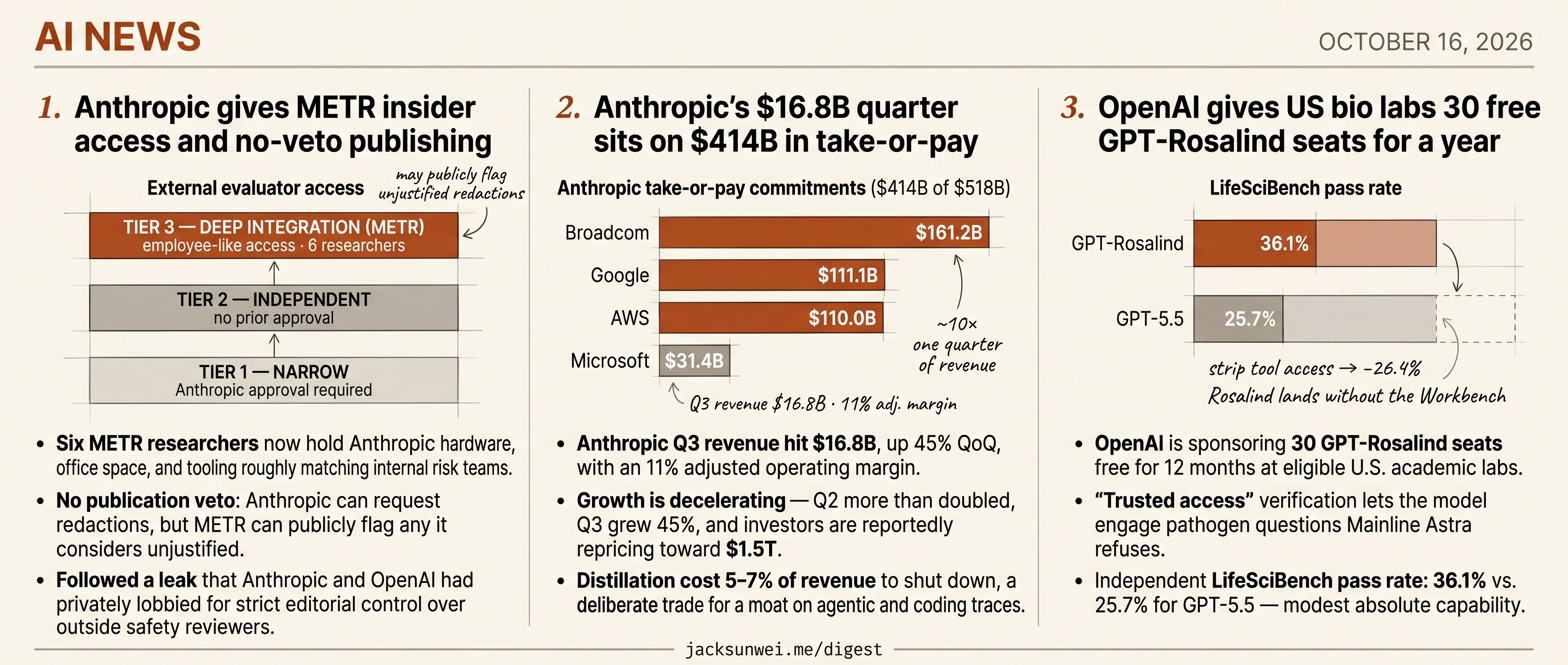
- Six METR researchers now hold Anthropic hardware, office space, and tooling roughly matching internal risk teams.
- No publication veto: Anthropic can request redactions, but METR can publicly flag any it considers unjustified.
- Followed a leak that Anthropic and OpenAI had privately lobbied for strict editorial control over outside safety reviewers.
- METR has already dissented, calling Anthropic’s “very low risk” claim for Opus 4.6 inadequately supported.
What actually changed
Anthropic’s Oct 15 post formalizes a three-tier framework for external evaluators and places METR at the top rung — “employee-like” visibility into training methodology, safeguard functions, and internal risk reporting, with carve-outs only for customer data, privileged legal material, and specific model architectures. Six METR staff have been issued company hardware and desk space. Crucially, Tier 3 includes the right to publish findings without Anthropic sign-off.
| Tier | Access | Publication rights |
|---|---|---|
| 1 — Narrow investigations | Scoped, Anthropic-controlled | Requires Anthropic approval |
| 2 — Independent publication | Broader | No prior approval; may critique redaction requests |
| 3 — Deep integration (METR) | Employee-like | No approval; may publicly flag unjustified redactions |
The redaction-dispute clause is the structurally novel bit. Anthropic can still ask METR to cut material it deems sensitive, but METR has unusual authority to tell the public when it thinks a redaction is hiding substantive risk 1. That mechanism didn’t exist in earlier evaluator arrangements.
The lobbying backdrop
Read in isolation, this looks like a principled transparency move. Read against the preceding week, it looks like a concession. Two days before Anthropic’s post, TechTimes reported that both Anthropic and OpenAI had privately lobbied for “strict editorial authority” over outside safety reviewers’ publications — even as their CEOs publicly pledged editorial independence 2. The no-veto clause now headlining Anthropic’s framework is the exact power the company was reportedly fighting to keep.
The contrast with OpenAI sharpens things further. The same news cycle included OpenAI firing three safety researchers — Korbak, Wang, and Balesni — who publicly characterized the dismissals as a “chilling” tactic designed to cover a retreat from independent-auditing commitments 3. Anthropic’s move reads generously only against that counterfactual.
The independence critique
The most pointed skepticism comes from SE Gyges at VerySane AI, who argues METR cannot function as a meaningful check because of overlapping staff, shared physical space at the Constellation research hub, and raw scale mismatch:
A handful of nonprofit researchers cannot effectively monitor a multi-billion-dollar organization’s entire training pipeline 4.
Business Insider adds a financial angle: Dario Amodei has floated evaluator salaries as high as $687,000 to keep auditors competitive with private-sector offers 5. Lab-funded compensation at that level sits uncomfortably alongside the “financial independence” criterion Anthropic itself lists as essential for credible evaluation.
Why METR’s track record is the strongest rebuttal
The best argument that this isn’t theater is METR’s own behavior. In its review of Anthropic’s automated-R&D risk assessment, METR publicly concluded that the company’s “very low risk” claim for Opus 4.6 was not adequately supported, flagged small and uncalibrated survey samples, and criticized Anthropic for modeling only full automation while ignoring the nearer-term threat of R&D acceleration 6. That is a non-trivial public contradiction of a flagship safety claim — evidence the publication-autonomy clause has teeth.
The honest read: this is a negotiated settlement, not a first-principles design. Its credibility will be decided by the first redaction dispute that plays out in public, not by the framework document itself.
Further reading
- Anthropic is letting METR researchers look under the hood with employee-level access — techcrunch-ai
Anthropic’s $16.8B quarter sits on $414B in take-or-pay
Source: simon-willison · published 2026-10-15
TL;DR
- Anthropic Q3 revenue hit $16.8B, up 45% QoQ, with an 11% adjusted operating margin.
- Growth is decelerating — Q2 more than doubled, Q3 grew 45%, and investors are reportedly repricing toward $1.5T.
- Distillation cost 5–7% of revenue to shut down, a deliberate trade for a moat on agentic and coding traces.
- Two customers drove ~25% of 2025 revenue — Cursor and GitHub Copilot, both now rivals to Claude Code.
The headline number, with asterisks
Anthropic’s investor day produced the cleanest financial picture the company has ever disclosed: Q1 of $4.8B, Q2 of $11.5B, Q3 of $16.8B, an adjusted operating margin of 11%, and $1.70 of revenue for every $1 of compute spend. The decision to abandon “annualized run-rate” framing in favor of actual quarterly results reads as IPO prep — and so does the willingness to publish unit economics at all.
The trajectory is less flattering than the raw numbers suggest. Q2 more than doubled Q1; Q3 grew 45%. That’s still a staggering absolute curve, but prospective investors are reportedly discussing a revised valuation closer to $1.5 trillion, specifically citing the deceleration 7. There is also an accounting wrinkle worth pricing in: independent analysis argues Anthropic books cloud-marketplace sales on a gross basis — full ticket as revenue, AWS/GCP cut as marketing expense — while OpenAI reports net of partner share 8. The $16.8B is not a direct apples-to-apples comparable to OpenAI’s run rate.
The compute obligation stack
The $1.70-per-$1-of-compute ratio looks healthy until you lay it next to the forward liabilities. Anthropic has reportedly locked in $518 billion of long-term infrastructure commitments, with roughly 80% ($414B) structured as non-cancelable take-or-pay 9:
| Partner | Commitment |
|---|---|
| Broadcom | $161.2B |
| $111.1B | |
| AWS | $110.0B |
| Microsoft | $31.4B |
An 11% adjusted margin is a different number when it has to compound against fixed obligations stretching toward 2036. The unit economics only work if revenue keeps compounding; if it plateaus, the take-or-pay stack becomes the story.
Distillation: a deliberate revenue trade
Willison’s napkin math — that competitors spent over half a billion dollars distilling Claude in Q2 alone — is corroborated by Anthropic’s technical response. The company deployed a two-stage classifier with a reported sub-0.1% false-positive rate, and specifically alleges Alibaba’s Qwen team ran roughly 25,000 accounts generating 28M+ exchanges targeted at Claude’s agentic reasoning and coding traces 10. Giving up 5–7% of revenue to kill that pipeline is a bet that the moat around agentic/coding capability is worth more than the API dollars it was producing — which, given what’s driving the rest of the business, is probably right.
The risks the pitch deck doesn’t lead with
Two structural issues sit under the growth curve. First, concentration: roughly 25% of 2025 revenue came from just two customers, Cursor and GitHub Copilot, even as Anthropic’s own Claude Code scaled from $500M to ~$15B ARR 11. Anthropic is now the largest competitor to its two largest buyers. Second, governance: NYC Comptroller Mark Levine, who oversees $325B in pension assets, formally asked Anthropic to delay the IPO — quoting CEO Dario Amodei’s own September “We Must Pace the Frontier” essay back at him 12.
The IPO pitch and the safety rhetoric are now being read against each other by the people who’d actually have to buy the stock.
OpenAI gives US bio labs 30 free GPT-Rosalind seats for a year
Source: openai-blog · published 2026-10-15
TL;DR
- OpenAI is sponsoring 30 GPT-Rosalind seats free for 12 months at eligible U.S. academic labs.
- “Trusted access” verification lets the model engage pathogen questions Mainline Astra refuses.
- Independent LifeSciBench pass rate: 36.1% vs. 25.7% for GPT-5.5 — modest absolute capability.
- Stripping tool access drops accuracy 26.4%, suggesting the Workbench does most of the lifting.
The gap the “trusted access” flow is meant to close
The headline of the Rosalind Academic Plan isn’t the free seats — it’s the verification layer that unlocks biology questions the rest of OpenAI’s lineup won’t touch. OpenAI’s own demo pits GPT-Rosalind against Mainline Astra on a Nipah virus l
Round-ups
FTC opens probe into OpenAI and Anthropic security incidents
Source: ars-technica-ai
The FTC is investigating whether security lapses at OpenAI and Anthropic harmed Americans, with fines on the table comparable to those for delayed breach disclosures. The probe lands after President Trump publicly dismissed AI risk concerns as a hoax.
Meta and Apple ship Muse Spark Open, tuned for M5 Macs
Source: the-verge-ai, techcrunch-ai
Meta’s new Muse Spark Open is billed as the most capable US open-weight model to date, co-engineered with Apple to run locally via the MLX framework. The claimed desktop target: two Apple M5 Ultra Mac Studios.
Anthropic details Claude safeguards for 2026 US midterms
Source: anthropic-news
Anthropic laid out its election-integrity plan for the 2026 US midterms, covering misuse monitoring, policy enforcement on Claude, and partnerships with election officials. The post extends measures first rolled out during the 2024 presidential cycle.
Modal hits $1B ARR and $16B Series D on sandbox demand
Source: latent-space
Serverless infra startup Modal reached $1B ARR and raised a $16B Series D, tripling both usage and valuation in five months and growing 15x year over year. Sandboxed code execution for AI agents is driving the surge.
ChatGPT’s Chrome extension gains access to open browser tabs
Source: the-verge-ai
OpenAI updated its ChatGPT Chrome extension to read open tabs when users tag Chrome inside the web or desktop app, replacing capabilities lost when the standalone Atlas browser was shelved. A demo video shows the assistant pulling context across tabs.
Sullivan & Cromwell builds OpenAI-powered contract review tool
Source: openai-blog
Law firm Sullivan & Cromwell worked with OpenAI to build Agreement Analyzer, which flags issues in draft contracts. The tool brings a white-shoe firm’s review playbook into an AI workflow aimed at speeding early-stage deal diligence.
Nick Cammarata claims agents disprove neuron polysemanticity
Source: latent-space
Interpretability researcher Nick Cammarata argues that agent-based probing techniques overturn the polysemanticity assumption, with implications for alignment work that has long treated superposed features as a hard constraint. Latent Space flags the claims as major and out of nowhere.
Footnotes
-
Cryptopolitan — https://www.cryptopolitan.com/anthropic-gives-up-veto-metr-safety-reports/
↩METR holds the unique authority to publicly flag when such redactions are used to obscure significant risks
-
↩Anthropic and OpenAI had privately lobbied for strict control over what evaluators could publish, citing the need to protect trade secrets and proprietary model architectures
-
SecurityWeek — https://www.securityweek.com/openai-fires-3-safety-researchers-in-dispute-over-ai-risks/
↩OpenAI terminated several safety researchers… claiming their dismissals were a ‘chilling’ tactic intended to provide cover for the company to retreat from its commitments to independent auditing
-
VerySane AI (SE Gyges) — https://www.verysane.ai/p/is-metr-a-meaningful-check-on-anthropic
↩METR staff share strong social ties with Anthropic employees and operate out of the Constellation research center… a handful of nonprofit researchers cannot effectively monitor a multi-billion-dollar organization’s entire training pipeline
-
Business Insider — https://www.businessinsider.com/anthropic-ai-safety-watchdogs-metr-dario-amodei-2026-10
↩Anthropic CEO Dario Amodei recently proposed that evaluators receive salaries as high as $687,000 to remain competitive with private sector talent, sparking debate over whether such funding could compromise auditor neutrality
-
Trending Topics (on METR review of Anthropic’s R&D risk report) — https://www.trendingtopics.eu/claude-opus-5-5-anthropic-launches-new-top-model-despite-calling-for-ai-slowdown/
↩METR argued Anthropic’s claim of ‘very low’ risk from its Opus 4.6 model was not adequately supported… Anthropic’s focus on full automation ignored the intermediate threat of R&D acceleration
-
Investing.com — leaked prospectus analysis — https://www.investing.com/analysis/what-anthropics-leaked-prospectus-reveals-ahead-of-its-ipo-200689031
↩Some prospective investors are discussing a revised valuation of roughly $1.5 trillion… sequential growth is slowing; though Q3 revenue jumped 45% to $16.8 billion, this represents a deceleration from the second quarter, when revenue more than doubled.
-
Remio.ai — cloud accounting comparison — https://www.remio.ai/post/anthropic-openai-revenue-looks-comparable-until-cloud-accounting-changes-the-sco
↩Anthropic utilizes ‘gross channel accounting,’ booking the full value of sales made through cloud partners like Amazon as revenue while treating the partner’s cut as a marketing expense. In contrast, OpenAI typically reports revenue net of its partners’ shares.
-
TechTarget — $518B infrastructure commitments report — https://www.techtarget.com/it-infrastructure/news/366651336/Report-Anthropic-locks-in-518B-AI-infrastructure-commitments
↩Approximately 80% ($414 billion) of the total commitment is reported as non-cancelable or payable regardless of actual usage… Broadcom: $161.2 billion; Google: $111.1 billion; Amazon (AWS): $110 billion; Microsoft: $31.4 billion.
-
AI Weekly — distillation defenses coverage — https://aiweekly.co/alerts/anthropic-says-new-defenses-cut-distillation-harvest-90-99
↩Anthropic alleged Alibaba utilized nearly 25,000 accounts to generate over 28 million exchanges, specifically targeting Claude’s agentic reasoning and software engineering skills… a two-stage classifier with a reported false-positive rate of less than 0.1%.
-
BusinessEngineer.ai — platform dilemma analysis — https://businessengineer.ai/p/anthropics-platform-dilemma
↩Nearly 25% of its 2025 revenue was generated by just two customers… identified as the AI-first code editor Cursor and GitHub Copilot… Claude Code reached an estimated $15 billion ARR by August 2026, growing from just $500 million a year prior.
-
PYMNTS — NYC Comptroller letter — https://www.pymnts.com/news/artificial-intelligence/2026/nyc-comptroller-urges-anthropic-to-delay-ipo-and-focus-on-ai-safety/
↩New York City Comptroller Mark Levine, who oversees $325 billion in public pension assets… urged the company to pause its public debut, citing Amodei’s September 2026 essay ‘We Must Pace the Frontier,’ where the CEO called for an industry-wide slowdown.