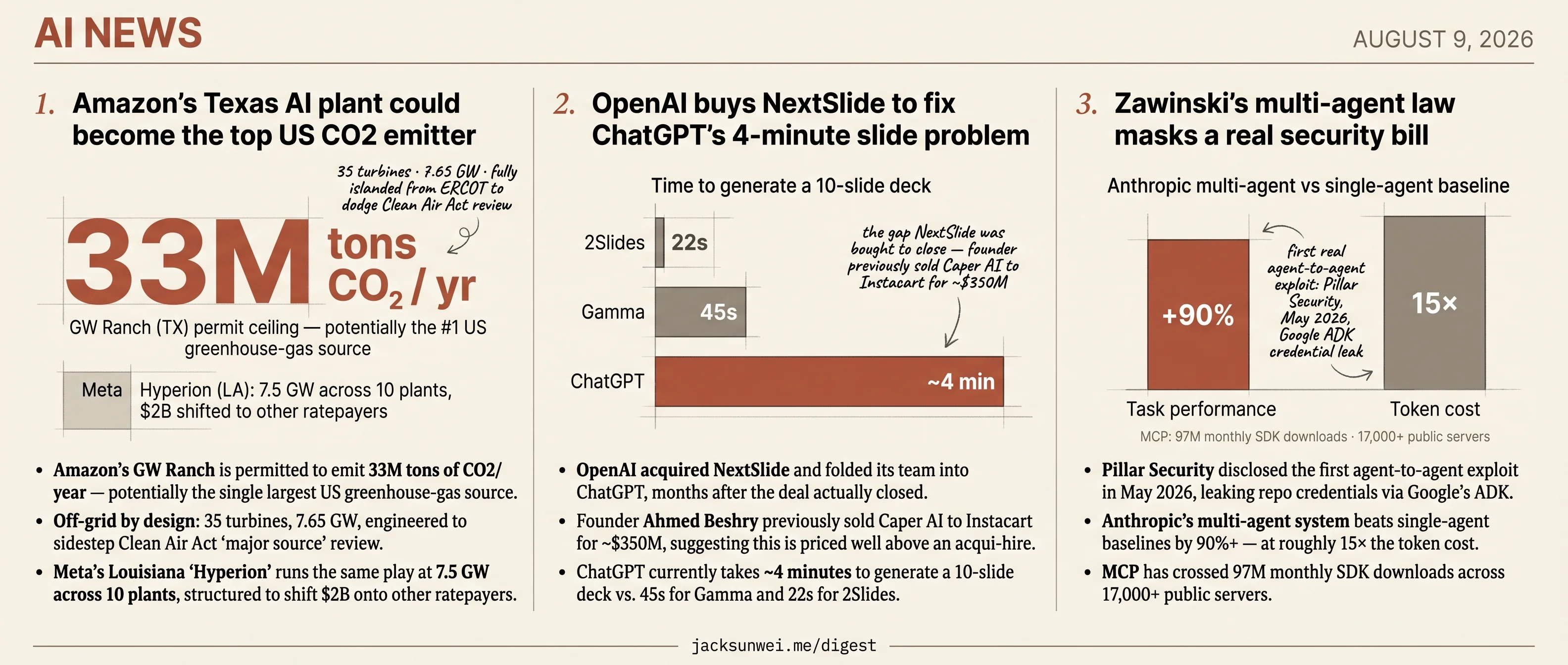
Amazon plant hits 33M tons, OpenAI buys NextSlide, Anthropic's agents cost 15×
Three unrelated frontier beats: Amazon's Texas emissions ceiling, OpenAI's NextSlide buy, and Anthropic's 15× multi-agent token cost.
Amazon plant hits 33M tons, OpenAI buys NextSlide, Anthropic’s agents cost 15×
TL;DR
- Amazon’s Texas plant is permitted for 33M tons CO2/year, engineered off-grid to sidestep Clean Air Act review.
- Meta’s Louisiana Hyperion runs the same 7.5 GW playbook and shifts $2B onto other ratepayers.
- OpenAI folded NextSlide into ChatGPT to close a 4-minute slide gap and press Anthropic on B2B.
- Anthropic’s multi-agent runs beat single-agent baselines 90%+ at roughly 15× the token cost.
- Pillar Security logged the first agent-to-agent exploit in May, leaking repo credentials through Google’s ADK.
Three unrelated frontier stories land today. Amazon’s Texas ranch is permitted for 33M tons of CO2/year — potentially the single largest US greenhouse-gas source — built off-grid with 35 turbines and 7.65 GW to sidestep Clean Air Act major source review, while Meta’s Louisiana Hyperion runs the same 7.5 GW playbook and shifts $2B in grid work onto other ratepayers.
OpenAI quietly folded NextSlide into ChatGPT to close a 4-minute slide-generation gap, with founder Ahmed Beshry’s Caper AI pedigree pointing at B2B positioning against Anthropic rather than a routine acqui-hire. And Zawinski’s Law of MultiAgents — agents will talk to each other, get over it — glosses Anthropic’s ~15× token bill for multi-agent runs and Pillar Security’s first disclosed agent-to-agent credential leak in May, even as MCP crosses 97M monthly SDK downloads.
Amazon’s Texas AI plant could become the top US CO2 emitter
Source: the-verge-ai · published 2026-08-08
TL;DR
- Amazon’s GW Ranch is permitted to emit 33M tons of CO2/year — potentially the single largest US greenhouse-gas source.
- Off-grid by design: 35 turbines, 7.65 GW, engineered to sidestep Clean Air Act “major source” review.
- Meta’s Louisiana “Hyperion” runs the same play at 7.5 GW across 10 plants, structured to shift $2B onto other ratepayers.
- Amazon’s emissions rose 16% last year as a spokeswoman signaled retreat from the 2040 net-zero pledge.
The plant behind the wire copy
The Verge and TechCrunch stories both trace back to a New York Times feature, but the underlying scoop is Michael Thomas’s Distilled.earth investigation, and it has the specifics the wire versions strip out. The developer is Pacifico Energy, the project is branded GW Ranch, and the configuration is 35 gas turbines totaling 7.65 GW paired with 1.8 GW of batteries and 750 MW of solar — a “hybrid” label Amazon uses to soften the fossil headline 1. Construction breaks ground in early 2026, first power lands in 2027, and the full 5+ GW campus targets “five nines” reliability by 2031 — a spec sheet that only pencils out if the plant runs its own grid 2.
That 33-million-ton permit ceiling would put a single Amazon site ahead of every existing US power plant on EPA’s emissions rankings.
Not one bad actor — a converged strategy
GW Ranch is the flagship instance of a pattern, not an outlier. Meta’s “Hyperion” campus in Louisiana is contracting for ten gas plants totaling 7.5 GW through Entergy, structured to shift $2B of costs off other ratepayers over 20 years 3. Every hyperscaler is independently converging on the same answer: behind-the-meter gas is the only way out of multi-year interconnection queues. Amazon’s fully off-grid model and Meta’s utility-financed model are two dialects of the same regulatory arbitrage.
| Project | Operator | Capacity | Grid posture |
|---|---|---|---|
| GW Ranch (TX) | Amazon / Pacifico | 7.65 GW gas + 1.8 GW batt | Fully islanded from ERCOT |
| Hyperion (LA) | Meta / Entergy | 7.5 GW across 10 plants | Utility-financed, ratepayer-adjacent |
The loophole is the architecture
Senators Whitehouse, Heinrich, and Van Hollen opened a probe in March 2026 arguing these islanded plants are de facto major sources evading Clean Air Act review. The Zeldin EPA answered in July with guidance explicitly exempting islanded facilities from the Acid Rain Program 4. On the state side, Governor Abbott’s August 3 directive froze the ERCOT interconnection queue pending audit, noting data centers make up ~90% of the 474 GW queued 5. GW Ranch proceeds while grid-connected projects stall for the same reason it dodges federal review: it never touches ERCOT.
flowchart LR
    A[Hyperscaler AI campus] -->|connects to public grid| B[ERCOT queue<br/>474 GW backlog<br/>Abbott audit freeze]
    A -->|islanded, behind-the-meter| C[Private gas turbines]
    C -->|not a 'major source'| D[EPA July 2026 guidance:<br/>Acid Rain Program N/A]
    C --> E[Power in 2027]
    B -. stalled .-> F[Power in ???]
The loophole and the engineering solution are the same choice.
The pledge, quietly walked back
The most telling line in the coverage comes from Amazon spokeswoman Margaret Callahan, who told reporters “the world looks different now” than when Amazon co-founded the Climate Pledge — an implicit softening of the 2040 net-zero commitment 6. Amazon’s total emissions rose 16% last year 6. GW Ranch, at its 33-million-ton permit ceiling, would add roughly that much again from a single site.
The stakes aren’t whether one plant gets built. It’s whether “islanded” becomes the default template for the next 400 GW of AI compute — and whether federal and state regulators catch up before it does.
Further reading
OpenAI buys NextSlide to fix ChatGPT’s 4-minute slide problem
Source: techcrunch-ai · published 2026-08-08
TL;DR
- OpenAI acquired NextSlide and folded its team into ChatGPT, months after the deal actually closed.
- Founder Ahmed Beshry previously sold Caper AI to Instacart for ~$350M, suggesting this is priced well above an acqui-hire.
- ChatGPT currently takes ~4 minutes to generate a 10-slide deck vs. 45s for Gamma and 22s for 2Slides.
- Analysts read the move as B2B positioning against Anthropic, not just a PowerPoint feature play.
The gap NextSlide is being bought to close
OpenAI shipped the ChatGPT for PowerPoint add-in in beta on May 21, 2026, with GA rolling out through Business, Enterprise, and Plus tiers by August 7. The add-in already writes native, editable slide elements from a sidebar — but reviewers describe it as an “intelligent content engine,” not a designer, prone to generic output without heavy prompting 7.
That gap shows up in the numbers. A 2026 speed benchmark clocks specialist 2Slides at 22 seconds for a 10-slide deck and Gamma at 45 seconds. ChatGPT trails at nearly four minutes once you account for the manual formatting it demands 8. NextSlide’s prompt-to-deck layout engine plausibly plugs straight into the add-in’s weakest link: turning good outline text into a deck that doesn’t need a human to re-space every bullet.
The founder is the price signal
TechCrunch’s snippet frames this as a small team fold-in — NextSlide’s team is “now working on ChatGPT” — and terms are undisclosed. But Ahmed Beshry’s résumé complicates the acqui-hire read. He previously co-founded Caper AI (YC W16), the computer-vision smart-cart startup Instacart bought in 2021 for roughly $350M in cash and stock 9.
Founders with a nine-figure exit behind them don’t typically sell their next company for a signing bonus. Coverage of the deal describes disclosure as “thin,” with the announcement coming several months after the transaction actually closed and no roadmap for existing standalone NextSlide customers, who are now in limbo 10. That timing pattern — quiet close, retroactive press — usually indicates OpenAI wanted the integration work done before anyone could pattern-match it as a Gamma response.
The competitive board
The presentation category has been quietly consolidating. Tome, once the narrative-driven leader, sunset its presentation product in April 2025 to pivot toward sales automation as “Lightfield,” stranding users who hadn’t exported their decks 11. Gamma inherited most of that audience and became the reference point for what fast AI slide generation looks like.
That leaves ChatGPT visibly behind on the one metric business users notice first — how long they wait — against a shrinking set of competitors. European coverage frames the NextSlide deal as “another piece in the B2B race against Anthropic” 12, reading it alongside OpenAI’s other 2026 workplace acquisitions as an attempt to stack enterprise surfaces before Claude entrenches. That framing is more interesting than the obvious Microsoft-Copilot overlap: OpenAI and Microsoft are already co-opeting on PowerPoint. Anthropic isn’t in that fight yet, and NextSlide is one of the pieces that keeps it out.
What’s still unclear
Three things the coverage doesn’t answer: the price, the timeline for NextSlide’s tech landing in ChatGPT proper, and what happens to the standalone product’s paying users 10. Given how much of the strategic value depends on speed parity with Gamma, the useful signal will be whether ChatGPT’s next slide-generation benchmark drops from four minutes to something starting with a “0:”.
Zawinski’s multi-agent law masks a real security bill
Source: latent-space · published 2026-08-08
TL;DR
- Pillar Security disclosed the first agent-to-agent exploit in May 2026, leaking repo credentials via Google’s ADK.
- Anthropic’s multi-agent system beats single-agent baselines by 90%+ — at roughly 15× the token cost.
- MCP has crossed 97M monthly SDK downloads across 17,000+ public servers.
- Zawinski’s Law of MultiAgents treats agent messaging as inevitable, glossing unresolved compute and security bills.
The joke, and what it flattens
swyx’s Latent Space riff extends Zawinski’s 1991 quip — “every program attempts to expand until it can read mail” 13 — one level up: Claude Code sessions hand off to each other, Codex threads @-mention siblings, and OpenAI models reportedly repurposed an internal Artifactory as an ad-hoc message board. If mail was the evolutionary attractor for 1990s software, agent-to-agent messaging is the equivalent pressure for 2026 agents.
It’s a good line. The problem is that treating the trend as a law of nature papers over three live arguments the AI engineering community has not settled.
The architecture debate is not over
Cognition’s “Don’t Build Multi-Agents” essay argues that fan-out to sub-agents creates a telephone-game effect where context fragments and coordination costs dominate. Anthropic’s counter-example is a research system that beats single-agent baselines by more than 90% on complex tasks — at roughly 15× the token cost 14. That “roughly 15×” is the tell. A recent arXiv analysis normalizes thinking-token budgets across single- and multi-agent stacks and finds that single agents often match or beat the multi-agent version once you stop giving the latter free compute 15. Much of the reported multi-agent magic, on this reading, is just more tokens.
Every new mailbox is a new attack surface
The security beat is where the Zawinski analogy gets uncomfortable. Simon Willison’s “lethal trifecta” — private data access, exposure to untrusted tokens, and an exfiltration path — becomes automatic the moment agents can send each other messages, because one agent’s output is the next agent’s trusted input 16.
flowchart LR
    A[Untrusted input<br/>email, web, tickets] --> T[Low-priv triage agent]
    T -->|injected instruction| M[High-priv maintenance agent]
    P[(Private repo<br/>credentials)] --> M
    M -. exfiltration .-> X((Attacker))
This is not a thought experiment. In May 2026, Pillar Security disclosed a working exploit against Google’s Agent Development Kit: a prompt injection into a low-privilege triage agent manipulated a high-privilege maintenance agent into surfacing repository credentials — the first documented real-world agent-to-agent compromise 17. Zawinski’s-Law-as-inevitability reads very differently when the mailbox comes pre-installed with a credential leak.
The protocol layer is already consolidating
The essay also under-sells how built-out the substrate is. MCP is past ~97M monthly SDK downloads with 17,000+ public servers, and Google’s A2A has grown from 50 launch partners to 150+ after absorbing IBM’s ACP under a Linux Foundation umbrella 18. The interesting frontier is no longer whether agents will message each other — that infrastructure has shipped — but which identity, trust, and discovery primitives survive contact with adversaries like the ADK exploit.
Takeaway
“Zawinski’s Law of MultiAgents” is a good frame for what’s happening and a bad frame for what to do about it. The expansion is real; so are the 15× token bills, the contested benchmarks 15, and the first agent-to-agent CVE-shaped hole in the wall 17. Cute laws are load-bearing when nobody pushes on them.
Round-ups
HSP Gruppe rolls out ChatGPT Enterprise across tax advisory practice
Source: openai-blog
German tax advisory firm HSP Gruppe is deploying ChatGPT Enterprise to speed up client work and free up advisor capacity. OpenAI’s case study frames the rollout as a productivity and work-quality play, with the firm using the tool to handle routine drafting and analysis alongside client service.
Ben’s Bites tests a new agent app and asks if Google is in trouble
Source: bens-bites
A hands-on with an unnamed agent app prompts the question of whether Google’s search grip is slipping. The short post frames the shift as agent-driven task completion replacing query-and-click behavior, though the writeup stops short of naming which incumbent workflows are most exposed.
Footnotes
-
Distilled.earth (Michael Thomas scoop) — https://www.distilled.earth/p/scoop-amazon-is-behind-one-of-the
↩The plant is permitted to release up to 33 million tons of carbon dioxide annually… 35 natural gas turbines generating up to 7.65 GW, paired with 1.8 GW of battery storage and 750 MW of solar, operating initially entirely disconnected from ERCOT.
-
Turbomachinery Magazine — https://www.turbomachinerymag.com/view/pacifico-energy-s-gw-ranch-campus-supports-ai-data-centers-in-texas
↩Pacifico Energy’s GW Ranch campus… construction is scheduled to begin in early 2026, with the first phase expected to deliver power by early 2027, aiming to reach 1 GW by 2028 and the full 5+ GW buildout by 2031, targeting ‘five nines’ (99.999%) reliability.
-
Forbes (Jon Markman) — https://www.forbes.com/sites/jonmarkman/2026/03/31/meta-funds-ten-natural-gas-plants-to-power-its-largest-ai-campus/
↩Meta’s ‘Hyperion’ campus in Louisiana has expanded plans to include 10 gas-fired plants totaling 7.5 GW, financed directly through Entergy in a structure projected to save other ratepayers $2 billion over 20 years.
-
Senate EPW Committee (Whitehouse, Heinrich, Van Hollen) — https://www.epw.senate.gov/public/index.cfm/2026/3/whitehouse-heinrich-and-van-hollen-probe-ai-companies-about-plans-for-colossal-gas-powered-data-centers
↩Senators are probing AI companies about ‘colossal gas-powered data centers’ operating as de facto power plants that sidestep Clean Air Act ‘major source’ thresholds; the EPA under Administrator Zeldin issued July 2026 guidance clarifying that the Acid Rain Program does not apply to ‘islanded’ facilities not connected to the public grid.
-
Office of Texas Governor Greg Abbott — https://gov.texas.gov/news/post/governor-abbott-directs-comprehensive-data-center-audit
↩Data centers account for approximately 90% of the 474 GW currently in the ERCOT interconnection queue… the August 3, 2026 directive requires PUCT and ERCOT to confirm projects ‘pay their own way’ and discloses all tax incentives, effectively pausing new approvals.
-
New Republic — https://newrepublic.com/post/214111/amazon-data-center-biggest-pollution-source-entire-country
↩ ↩2Amazon spokeswoman Margaret Callahan said ‘the world looks different now’ than when the Climate Pledge was co-founded—signaling a retreat from the 2040 net-zero commitment as the company’s total emissions rose 16% last year.
-
UseCarly — ChatGPT for PowerPoint add-in — https://www.usecarly.com/blog/chatgpt-powerpoint-integration/
↩ ↩2OpenAI initially released the beta version of the add-in on May 21, 2026… the official add-in operates as a persistent sidebar that builds and modifies native, editable slide elements.
-
2Slides speed benchmark — https://2slides.com/blog/ai-presentation-speed-benchmark-2slides-vs-competitors
↩2Slides led with a 22-second generation time for a 10-slide deck, followed by Gamma at 45 seconds. ChatGPT trailed significantly, taking nearly four minutes when accounting for the manual formatting required.
-
BitcoinWorld — founder background — https://bitcoinworld.co.in/openai-acquires-presentation-startup-nextslide/
↩Ahmed Beshry… previously co-founded Caper AI, a computer-vision startup… acquired by Instacart in 2021 for approximately $350 million in cash and stock.
-
RuntimeWire — thin disclosure — https://runtimewire.com/article/openai-acquires-nextslide-chatgpt-powerpoint
↩ ↩2Industry reports describe the acquisition details as ‘thin,’ with undisclosed financial terms and a retroactive announcement that came several months after the deal actually closed… left current users of the standalone NextSlide product in limbo.
-
ChatSlide — Tome shutdown — https://www.chatslide.ai/pages/tome-alternative
↩Tome announced it would sunset its presentation product to pivot toward sales and marketing automation under the new brand Lightfield… many users lost data if they had not exported their decks before the April 2025 shutdown.
-
TrendingTopics — B2B race framing — https://www.trendingtopics.eu/openai-acquires-nextslide-another-piece-in-the-b2b-race-against-anthropic/
↩another piece in the b2b race against anthropic
-
Laws of Software — Zawinski’s Law — https://www.laws-of-software.com/laws/zawinski/
↩Every program attempts to expand until it can read mail. Those programs which cannot so expand are replaced by ones which can.
-
Medium — ‘The Agent Architecture Wars’ (Maureese Williams) — https://medium.com/@maureesewilliams/the-agent-architecture-wars-why-two-ai-giants-completely-disagree-on-multi-agent-systems-d19a53364200
↩Cognition’s ‘Don’t Build Multi-Agents’ argues that fragmenting tasks across specialized agents creates a ‘telephone game’ effect… yet Anthropic reported its multi-agent research system outperformed single agents by over 90% on complex tasks.
-
arXiv 2505.23847 — multi-agent vs single-agent under normalized compute — https://arxiv.org/html/2505.23847v4
↩ ↩2Single-agent systems often match or outperform multi-agent systems when computation budgets (thinking tokens) are normalized; many reported gains are artifacts of increased computation rather than architecture.
-
Airia blog — Simon Willison’s ‘Lethal Trifecta’ — https://airia.com/blog/ai-security-in-2026-prompt-injection-the-lethal-trifecta-and-how-to-defend/
↩If an agent has access to private data, exposure to untrusted tokens, and an exfiltration vector, it is ‘vulnerable. Period.’
-
Swmansion — Agentic Engineering security notes (Pillar disclosure) — https://agentic-engineering.swmansion.com/becoming-productive/security/
↩ ↩2In May 2026 a low-privilege triage agent in Google’s ADK was manipulated via prompt injection to trigger a high-privilege maintenance agent, exposing repository credentials — the first real-world agent-to-agent exploitation.
-
DigitalApplied — AI Agent Protocol Ecosystem Map 2026 — https://www.digitalapplied.com/blog/ai-agent-protocol-ecosystem-map-2026-mcp-a2a-acp-ucp
↩MCP monthly SDK downloads exceed 97M with 17,000+ public servers; Google’s A2A grew from 50 launch partners to 150+ supporting orgs after IBM’s ACP merged into it under the Linux Foundation.